by Barry Clarke
Matching hatching and egg-laying caddisflies is critical to successful dry fly fishing. Barry Clarke shares a fly box full of his favorite patterns that will catch trout around the world.
On the mountain lakes of my home waters here in Norway, the fishing always starts slow, waiting for warmer weather and the thaw. We anticipate the first signs of spring and the ice breaking up, which normally occur around the middle of May. The first, short hatches are small midges. Matching these tiny insects requires using super-fine tippets and the smallest hook sizes; this can be some of the most frustrating fishing of the season. The fish, still lethargic after a long, cold winter under the ice, can be extremely selective.
A little later, as the air and water warm up—sometime around the third week of June—the first caddisflies begin hatching. This is without a doubt one of the highlights of each fishing season. Like all fly anglers, I have my favorite caddis patterns, some dry and some sub-surface.
When the adult caddisflies start skating across the surface of the water, however, the fishing becomes about as exciting as it can get. Dragging a large caddisfly imitation across the surface isn’t the most delicate side of our sport, but sometimes it’s required if you wish to catch trout. But then, watching the water bulge behind your fly as a fish chases it and prepares to strike can be a real knee trembler!
Usually, I go into great length in my articles, teaching you how to tie one pattern. Sometimes, like in my recent in-depth article about deer hair, we explore the nuances of using a single fly-tying ingredient. This time, for a change of pace, I want to share with you a collection of some of my favorite patterns.
Here are 16 of the best caddis dry fly patterns populating my fly box. No doubt you will be familiar with at least a couple of them, but I’m pretty sure some of these flies will be new to you. All catch fish and are worthy additions to your fishing kit. And although most of these patterns float well, they will all benefit from a dressing with your preferred dry fly floatant.

Rakklehanen
Hook: Mustad R30-94833, sizes 18 to 10.
Thread: Brown 8/0 (70 denier).
Body and head: Polypropylene yarn cut and blended into dubbing.
Wing: Polypropylene yarn.
This is a popular pattern in Scandinavia from Kenneth Bostrøm, a well-known rod builder and fly tier. The polypropylene yarn used in this pattern is very coarse. For tying the body, cut the yarn into short lengths and use as a dubbing. The wing is a single piece of yarn tied in at the thorax and folded back to make a double wing. The head is also dubbing.

Deer-Hair Caddis
Hook: Mustad R30-94833, sizes 18 to 10.
Thread: Gel spun.
Body: Natural deer hair.
Wing: Synthetic raffia.
Head: Natural deer hair.
This pattern, which uses the buoyancy of late-season deer hair, is quick and simple to tie. The body is deer hair spun in a dubbing loop, wrapped on the hook, and trimmed to form a Goddard Caddis–shaped body. The wing is doubled synthetic raffia tied on over the body. The collar and head are long deer hair applied in a dubbing loop.
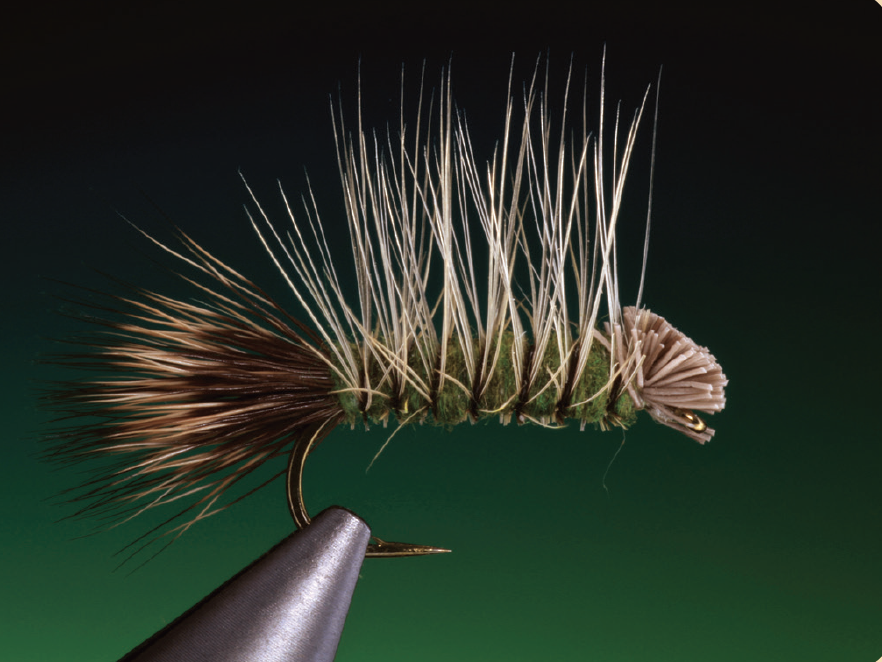
Dyret
Hook: Mustad Mustad R30-94833, sizes 16 to 10.
Thread: Gel spun.
Tail and underbody: Natural deer hair.
Body: Super Fine Dry Fly Dubbing.
Head: Natural deer hair.
Hackle: Brown or badger.
The Dyret, or “animal” as it’s known in Norwegian, is a relatively new pattern, but Scandinavian fly fishers have embraced it with open arms. Its inventor, Gunnar Bingen, developed this fly for fishing for trout and grayling on Norway’s famous Rena River. The deer hair used for this pattern should be from a winter coat, and it should long enough to grasp when trimming the head. You can decide what type of head you prefer. The head can be small and trimmed tight, or large and more open so that it pushes water when you drag the fly across the surface.

Diving Caddis
Hook: Mustad R30-94833, sizes 16 to 10.
Thread: Gel spun.
Body: Rust Super Fine Dry Fly Dubbing.
Butt and rib: Orange tying thread.
Wing: Two female mallard breast feathers.
Hackle: Speckled brown partridge.
Head: March brown and gray Antron dubbing.
Gary LaFontaine, in his book titled Caddisflies, might have been one of the first fly fishing authors to document the fact that some female adult caddisflies actually dive under the water to lay their eggs. Spying these insects on the water requires keen observation, but when you see caddisflies land and then disappear under the surface, try this pattern called the Diving Caddis. Then, pat yourself on the back: you will have taken a large step forward to matching the hatch.