Heavy, hydronamic, versatile, and effective.
Whether you love them or hate them, it’s hard to deny the effectiveness of perdigon-style flies for catching trout. As I understand it, these patterns were developed in Spain—perdigón is Spanish for “pellet”—popularized in France, and spread across the globe through international fly-fishing competitions. The effectiveness of perdigon patterns makes them popular, especially when fishing fast water. The designs generally employ tungsten beads, which help the flies sink quickly, and slim, varnished bodies that offer less resistance as they sink and move through the water. Most perdigon flies also have a hot spot. In addition, these patterns are exceptionally durable, require only a few materials, and can resemble a wide variety of aquatic macroinvertebrates during spring, which can be frustrating.
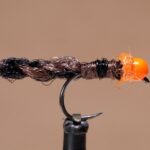
Although the Jig Napoleon is certainly perfectly suited to Euro nymphing techniques, it also fishes well beneath a floating indicator or in smaller sizes trailing a dry fly that floats well. This particular perdigon-style fly is called the Jig Napoleon. How it got its name, I’m not really sure, but it has been around for a while. I became aware of it, however, only this past spring while fishing in Patagonia. Most of the guides carried them, and these flies outproduced virtually all other subsurface flies used by our group. Depending on water conditions, we fished sizes 12, 14, and 16 in several different color combinations. All of them worked extremely well. I, for one, was sold and have been tying and using them here in the U.S. ever since.
The reason perdigons sink so fast is that they’re very heavy, and I’ve added lead-free round-wire wraps behind the bead to really get the fly down. A coating of UV resin over the entire body streamlines the fly, which further contributes to its sink rate, in addition to making it incredibly durable. By changing the colors of the underbody and the hotspot collar behind the head, tiers can produce Jig Napoleons to suit a wide variety of needs. The color combination shown here is definitely my favorite, but one with a darker abdomen and a fluorescent-green collar is a close second. I have a sneaking suspicion that it does a good job of imitating a cased caddis.
On all variations, I like a band of black thread behind the hotspot collar, as it seems to tie everything together and may—or may not—represent a wing case. The UV-resin coating should be fairly thin, yet thick enough to fill in between the wire-rib wraps.
This version of the Jig Napoleon is a bit simpler than the original, mainly because I have replaced the quill body with a mylar body topped with a wire rib. The quill body looks great, but pre-stripped quills can be costly and have a nasty tendency to break during tying, which can be frustrating.
Tim Flagler was this publication’s Fly Tyer of the Year in 2022. He is a leading fly-tying instructor, appears at tying shows across the U.S., and guides anglers to fly-fishing destinations worldwide. To learn more, visit tightlinevideo.com. Tim and his wife, Joan, live in New Jersey.
Jig Napoleon
Detailed instructions for tying a Jig Napoleon. This is part of a series of Tim Flagler’s collaboration with Fly Tyer Magazine. Check out his article about the fly in the Fall 2025 issue of Fly Tyer Magazine. Recipe: Hook: Any jig hook, here, Lightning Strike JF2 jig hook, sizes 12-16.