The Difference Between Having Inspiration and Being Inspired
I thought inspiration in fly tying meant concocting a pattern to imitate some sort of fish food that will capture a cold-blooded creature having the brain the size of a pea. (You should read that sentence twice. It’s important to the story.) For Tom, inspiration comes from meeting new people, getting to know them, and being helpful. He has to be inspired before creating a new fly.
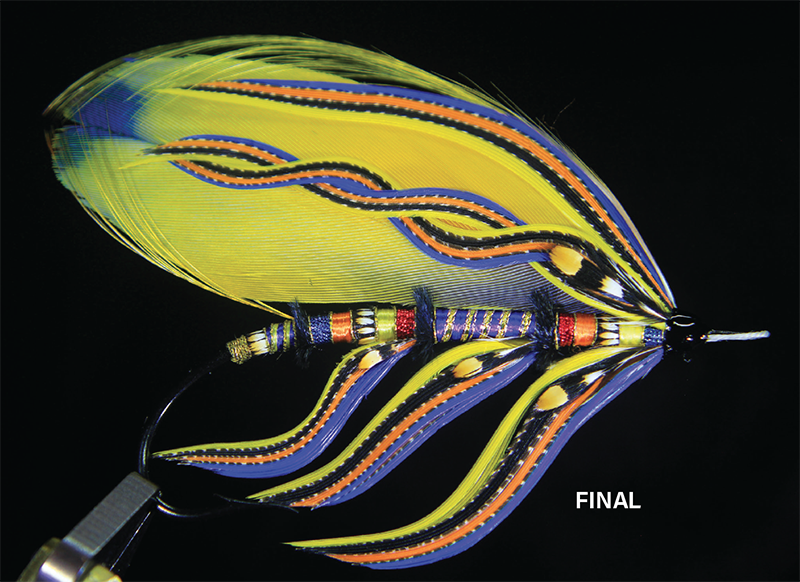
“As you can imagine, I started by tying classic full-dress salmon flies—the Green Highlander, Black Doctor, and patterns like that,” Tom said. “You don’t just jump into creating these types of ties; there is a huge learning curve. But I like thinking outside the box, so I developed my own methods and created patterns no one else was tying. After more than 20 years of tying, I was using materials and colors to create ties no one else had ever created. I was manipulating materials to get them to do what I wanted them to do. I also discovered that creating one of these ties requires some type of inspiration, a moment in time that draws me to the vise to create a tie that showcases that particular event. How I created the first tie is sort of a funny story.
“I remember stopping at an airport bookstore and spotting a Life magazine that showcased the history of the most iconic photographs. It included that image of Marilyn Monroe standing over a street grate with her dress billowing in the wind. My thought was not of viewing a pretty lady with her dress blowing up; instead, I wondered if I could create a tie to replicate that image. That was actually the first tie I made that I would call art. I’m not sure if anyone else would call it art, but it certainly wasn’t meant for tying to the end of a tippet. Tying that pattern took seven hours, and then it needed a home, so I framed it in a shadowbox and hung it in my tying room.”
Today, Tom’s inspiration comes from news events, accidental encounters with people, and meeting the family of loved ones who gave their lives in the service of this country and its communities. These are the grist for his fly-tying mill and provide nourishment for his creative soul. Sometimes, Tom will develop a new tying method to achieve a desired effect on a fly.
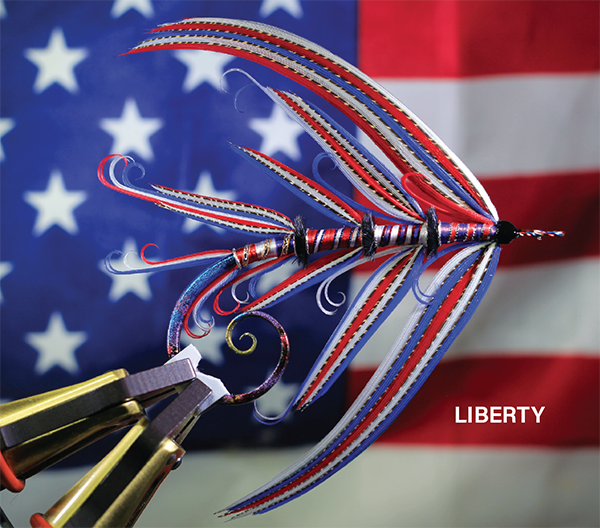
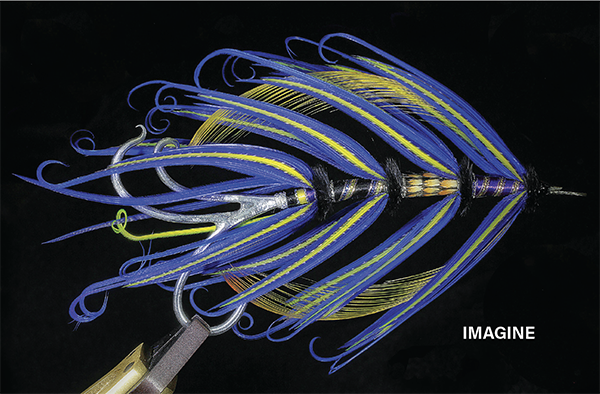
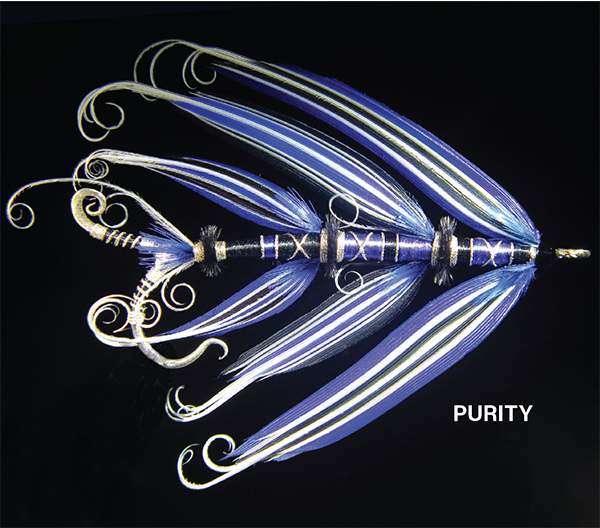
“Curling a slip of dyed turkey tail feather, and then marrying it back into the wing, was an idea that came to me in the middle of the night; I first used this technique to create a tie called Liberty. That fly had over 50 individual curls tied in to honor all the victims of the Las Vegas shooting in 2017.”
Tom continued talking about the sources of inspiration for his flies.
“I made a tie to commemorate the battle of Combat Outpost Keating, in Afghanistan, in which 300 Taliban fighters attacked the outpost and killed eight U.S. servicemen. I also met a lady while guiding at a Casting for Recovery retreat; sadly, she eventually lost her life due to breast cancer. And there was a family of a firefighter who loved to fly fish but gave his life trying to save another person. My passion for fly tying has allowed me to journey into and experience the suffering of other people. It has allowed me to better understand real courage and see how people deal with their personal tragedies.
“I might be contacted by a military family that lost someone in the service,” he continued. “It might turn out that the serviceman or woman loved fly fishing, and the family would like a framed fly to hang in their house as a memorial. That’s very powerful, so I’ll ask for their name, and also ask that they send a photograph of the person. I will do a little research to find out what happened. This creates the inspiration for designing a new pattern.
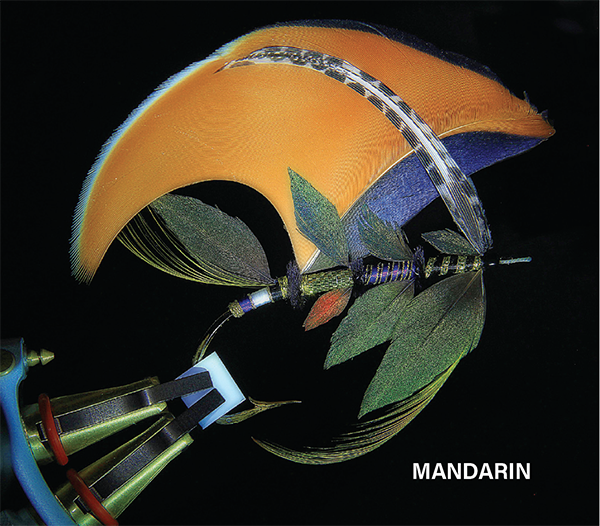
“Each tie has its own story, and no two are alike. Unfortunately, I just can’t fulfill all the requests.”
In addition to responding to requests from individuals, Tom occasionally creates original flies for fundraisers for leading national organizations.
“I have designed ties for organizations like Casting for Recovery, the American Cancer Society, the World Hunger Fund, Project Healing Waters, and Trout Unlimited. Altogether I think I’ve given away almost 70 framed flies over the past 15 years, but like I said, I can’t possibly fulfill all the requests. That would be impossible to do.”
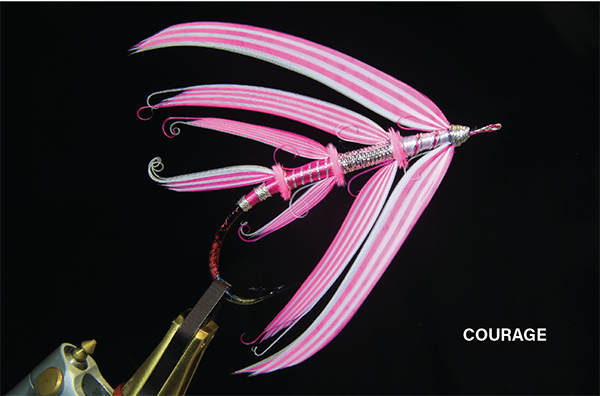
50 Hours In a Fly
In the end, of course, we are talking about fly tying, and Tom has to secure all those ingredients to hooks. It is a very exact and time-consuming process.
“I have to prep all the materials, marry the wings and other components, and then make the fly,” Tom said. “For example, I suspect tying Jose’s Tie took at least 30 hours. And then I have to do the framing. I do all my own framing, which takes another several hours. Altogether, completing one project requires 40 to 50 hours. But I love doing it, and I give them away. I earn no money from my ties.”
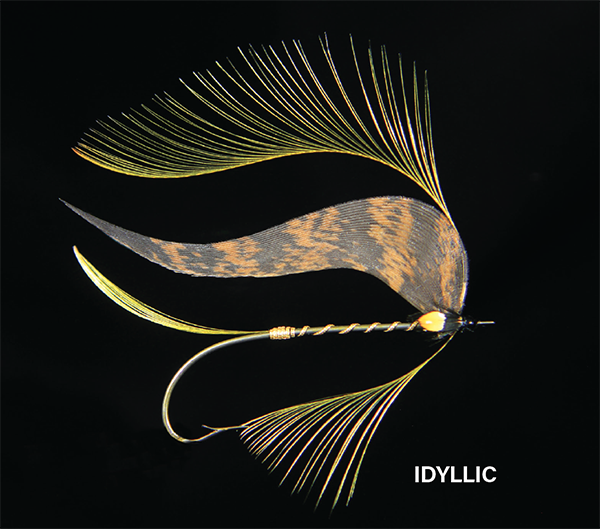
I marveled at his ability to create married wings. He has totally mastered this advanced fly-tying technique.
“Yes, there are a lot of married parts on many of my ties. And remember: every tie has two wings, tails, and almost everything else. What you see is matched and looks identical on the far side of the fly.”
Is finding high-quality materials difficult?
“The type of jungle cock I use on the bodies is getting hard to find. I like that golden color, and getting it in small sizes is tough. I pluck the feathers from the capes using tweezers, and then strip off the fibers from each base so they lay nicely against the hook. I tie them on the hook one at time; it’s tedious work. Finding really good dyed turkey center tail feathers is also tough, and they are expensive.”
All of a sudden Tom brought his craft down to earth and offered a piece of advice that applies to even mortal fly tiers like me.
“I don’t care if you’re tying this sort of fancy tie or a Woolly Bugger, the key is getting the materials to do what you want them to do. Each type of material has its own personality, and you’ve got to learn how to control those personalities. Doing what I do might be a lot more complicated, but regardless of what you tie, the principle is the same.”
I still struggle to tie flies that catch fish; that’s the source of my inspiration. I’ve been working on this problem for five decades, and occasionally I’m successful.
The next time I do succeed, I won’t pat myself on the back. All I did was lash some bits of feathers and fur to pieces of bent wire, and then used those fake bugs to trick the wet, finned things swimming in my local stream; remember, their brains are only the size of peas. Sure, I’ll enjoy the moment, but it will pass. Instead, I will be marveling at the artistic skill, technical ability, and boundless generosity of Tom Herr, and I will be thinking of the all the people he has freely helped with his one-of-a-kind ties.
______________________________________________________________________________
If you’d like to learn more about Tom Herr’s original patterns, and see the fly called Marilyn, go to his website, artisticflytying.com.
David Klausmeyer is the editor of this magazine.