by Tim Flagler
We here in the Eastern United States are fortunate in that we have really good Isonychia hatches. It’s a shame many regions of North America do not. Iso’s, as they’re known for short, are also called Slate Drakes, Mahogany Duns or Leadwing Coachmen.
Rarely do Iso’s produce blanket hatches. They, instead, prefer to dribble off in less than significant numbers during the evening and well into dark. The great thing though is this takes place over many months. Here in New Jersey, we’ll start seeing Iso’s as early as late May and sometimes they’re still around well into November. Because of this, trout seem to get accustomed to them being available and readily take them in all stages of development, throughout much of this period.
Isonychia nymphs generally emerge by first migrating to the shore, then crawling out onto rocks, where the winged adult emerges from its nymphal shuck. These nymphs are remarkable swimmers and use a kind of butterfly kick to propel themselves through the water. At times, they even resemble small minnows. This is why swung soft hackles and wets can be so effective. Dead-drift nymphing works well, fishing dun and spinner imitations is always fun and visual, but swung or stripped flies like soft hackles are a great way to change things up.
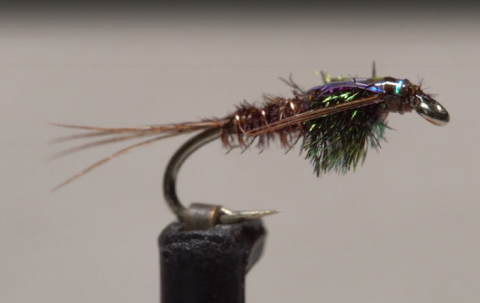
Isonychia Soft Hackle
Detailed instructions for tying an Isonychia Soft Hackle fly. This is part of a series of Tim Flagler’s collaboration with Fly Tyer Magazine. Check out his article about the fly in the Fall 2024 issue of Fly Tyer Magazine. Recipe: Hook: Nymph hook, here, Fulling Mill 5085, size 12.
Weightless soft hackle flies like this one, swung downstream and across, can produce truly aggressive takes. Of course weighted or bead head versions will also work, but I greatly prefer the weightless variety. If I need to get the fly down a little deeper, I’ll hang it off an intermediate, 3” per second or 5” per second poly leader. To me, the weightless versions of the fly present more naturally as they’re almost neutrally buoyant, just like the naturals.
This particular pattern, although definitely more suggestive than imitative, checks a lot of boxes. Pheasant tail fibers give it a short, feathery tail similar to the three tails found on the natural nymphs. A kind of rusty maroon-colored abdomen, segmented by a gold wire rib, adds a touch of attractive shimmer and realism. While perhaps not essential, a white stripe down the center of the fly’s back looks like the one found on many naturals. Peacock herl is used for the thorax because, in my estimation, it gives the illusion of movement and life with its iridescence. I prefer a soft hackle collar that’s well-marked, and with more fibers than on most soft hackle flies. I want the trout to view it as a meal, not just a light snack.
Wet flies and soft hackles seem to be making a comeback after decades of relegation to dusty, back row fly bins. Under certain conditions, they can be incredibly effective but, almost more importantly, they’re exceptionally relaxing and satisfying to fish. In addition, they possess a grace and elegance that’s lacking in many modern fly patterns. Of course, that’s just my opinion, yours may differ.
Recipe
Hook: Nymph hook, here, Fulling Mill 5085, size 12.
Thread: UTC 70 Denier, brown.
Rib: Small gold Ultra wire.
Tail: 6-8 pheasant tail fibers, dyed chocolate brown.
Dorsal stripe: UTC 140 Denier, white or white floss.
Abdomen: Fine & Dry Isonychia-colored dubbing.
Thorax: Peacock herl, 3-4 strands.
Collar: Hen feather, mottled brown.