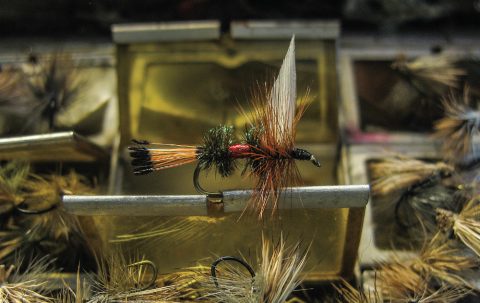
The Watershed Fly Shop, in my hometown of Corvallis, Oregon, is a prime example of this type of establishment, and Troy Haeslip, owner of this great business, is one of those dedicated Spey anglers. Troy spends much of his time on the water swinging flies for steelhead and trout. Local waters where trout reside include the Santiam, Willamette, and McKenzie River systems, and a little farther afield flows the famous Deschutes River. Troy loves helping anglers learn both the basics and the advanced nuances of Spey fishing for trout. I sat down with Troy to review gear for trout Spey.

COASTAL MUDDLER
Hook: Daiichi 2220, size 8.
Thread: Gray-brown 6/0 (140 denier).
Tail: Natural coastal deer hair.
Body: Gold holographic tinsel.
Rib: Amber Ultra Wire.
Wing: Copper/blue grizzly Krystal Flash.
Thorax: Root beer Enrico Puglisi Streamer Brush.
Trout Spey rods essentially overlap ultralight Spey rods, or what one manufacturer so accurately calls its “microspey” line of tackle. Available Spey rods range from the almost unthinkable 1-weight (which handles small rivers and trout beautifully) to 5-weight two-handers. Troy says most anglers steer toward 3- and 4-weight rods. He finds 4-weights the most versatile, and 5-weights to be a little big for many trout situations.
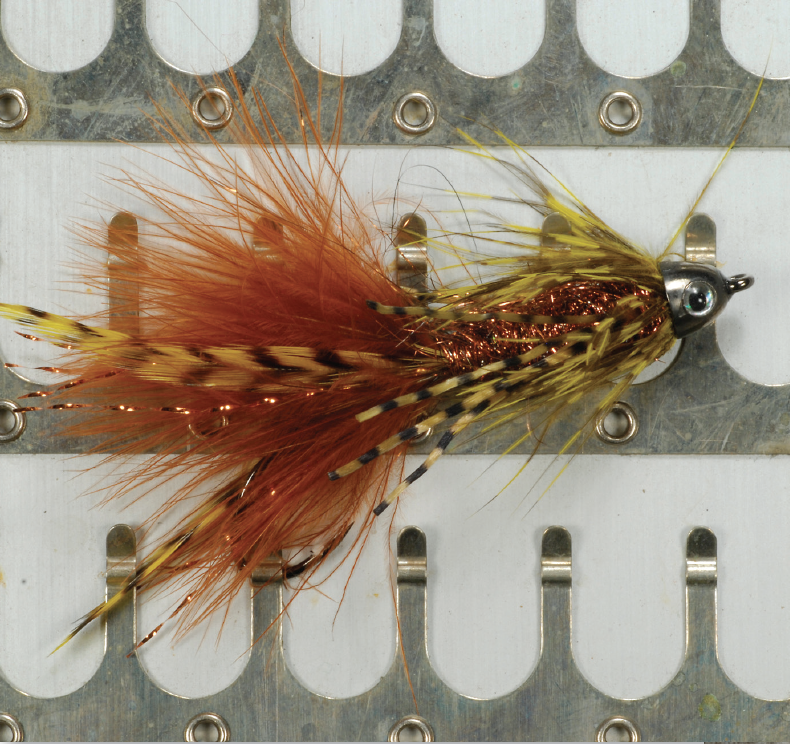
CHOU’S FORTUNE COOKIE
Shank: Any straight-eyed shank.
Connector: Berkley Steelon nyloncoated wire.
Hook: Gamakatsu Big River Bait, size 6.
Thread: Olive 6/0 (140 denier).
Head: Black-nickel Cross-Eyed Cone.
Tail: Olive-brown MFC Buggerbou, olive-grizzly hackle tips, and olive Krystal Flash.
Body: Olive Ice Dub
Legs: Barred olive rubber legs.
Collar: Olive guinea fowl.
Well-known Spey angler and casting instructor Simon Gawesworth says that when selecting a rod, a good rule of thumb is to double the line weight to match the size of trout you will target. In other words, a 3-weight rod is suited for fish weighing up to six pounds, a 4-weight rod will work well for eight-pound fish, and a 5-weight rod can handle Alaskan rainbows and small steelhead. Of course, smaller rods are best suited for using lighter trout Spey flies, while larger rods can handle more sink tips and heavier flies.
UNTANGLING THE MYSTERIES OF TROUT SPEY LINES
Trout Spey lines are evolving, and manufacturers are adding new and different products all the time. There are basically two styles of lines employed in trout Spey: heavier Skagit lines and lighter Scandi lines.
Skagit lines are the workhorses of Spey lines. Their shorter, heavy heads develop a lot of power quickly in trout Spey rods. Skagit heads range from the super-short micro Skagits featuring 11- to 26-foot-long heads. Shorter Skagit heads are best suited to typical trout Spey rod lengths. Anglers new to Spey casting typically find Skagit lines easier to use because these heavier lines load rods quickly and give anglers more “feel” while casting. These lines are ideal for casting larger, weighted flies such as streamers and Intruders, as well as heavier sinking tips.
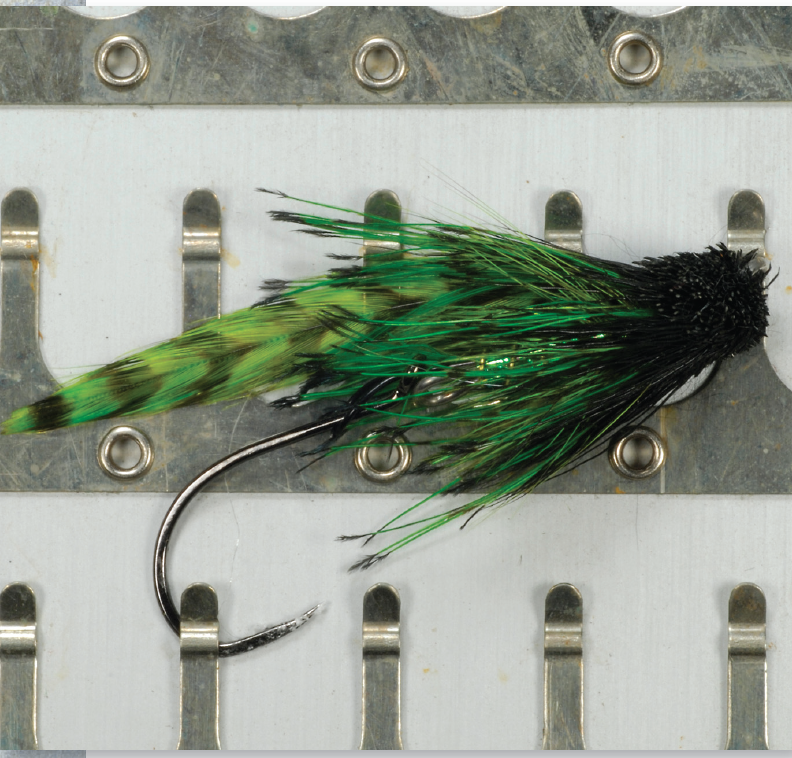
CHOU’S MOOSHOO MUDDLER
Shank: Any straight-eyed shank.
Connector: Berkley Steelon nyloncoated wire.
Hook: Gamakatsu Big River Bait, size 4.
Thread: Black 6/0 (140 denier).
Tail: Golden pheasant tippet dyed olive.
Rear body: Flat Mylar tinsel, color to match the fly.
Thorax: Olive-chartreuse Spirit River Bright Blend, brushed out and spiral-wrapped with a green grizzly saddle hackle.
Rib: Olive wire.
Collar: Golden pheasant tippet dyed olive.
Flash: Olive Angel Hair.
Wing: Olive grizzly saddle hackle. tips.
Head: Black elk belly hair.
The popularity of Scandi lines for trout Spey is growing. These are lighter lines, and are a good choice for fishing on or near the water’s surface. Scandi lines are essentially all front tapered and unroll very efficiently on the water. Anglers using Scandi lines achieve long distances, cast pretty loops, make soft presentations, and fish smaller flies effectively. Scandi line heads are longer than the heads on Skagit lines, with long front tapers, moderate belly lengths, and short rear tapers. A Scandi is my line-of-choice during hatches when I swing soft hackles.
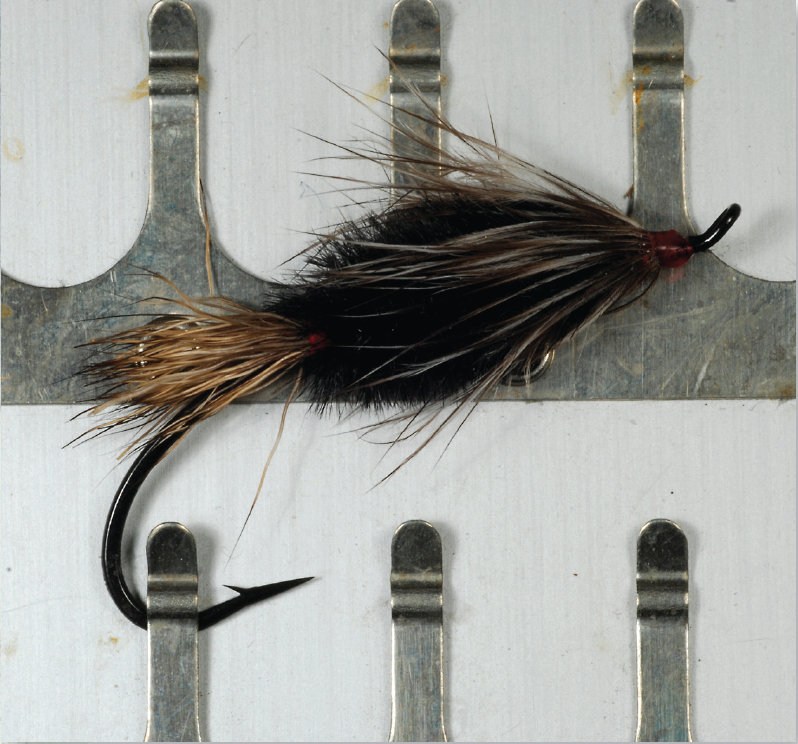
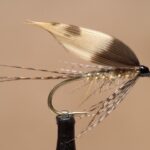
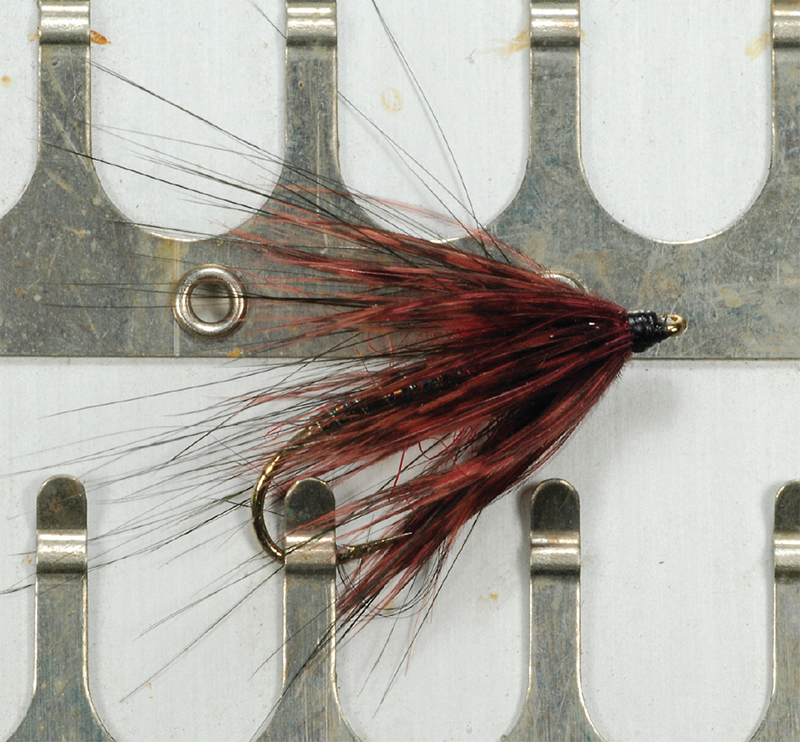
SPADE FLY
Hook: Alec Jackson Steelhead Iron, sizes 8 to 4.
Thread: Black gel spun.
Tail: Deer hair.
Body: Black chenille, black ostrich herl, or black dubbing.
Hackle: Grizzly soft hackle.
Both Skagit and Scandi lines are available as modular systems where the components are assembled using loop-to-loop connections. A trout Spey line can also be purchased as an integrated line; that is, the running line and shooting head are all one piece, much like a regular fly line. A modular Skagit system works well for me when casting bigger flies and the loop-to-loop connections are unnoticeable. When fishing soft hackles during a hatch, an integrated Scandi line works nicely for shooting line and strip-retrieving flies because there are no loop-to-loop connections going through the rod guides.

MINI STREAMER SPEY INTRUDER
Shank: Fish-Skull Senyo’s Micro Shank.
Connector: Black Senyo’s Intruder
Trailer Hook Wire.
Hook: Gamakatsu Octopus UV, size 4.
Thread: Orange gel-spun 14/0.
Dubbing ball: Light olive SLF Dubbing.
Tail flash: Silver MFC UV Sparkle Minnow Body Brush.
Body: Olive MFC Bunny Brush.
Side feathers: Brown cape hackles.
Hackle: Burnt orange speckled coq de Leon hen hackle.
Head cement: Solarez Ultra-Thin.
In the interest of keeping this simple, leaders used with Skagit systems are typically just lengths of tippet material; a three- to five-foot-long piece of 3X to 0X fluorocarbon will serve as a leader. For Scandi systems, a Polyleader or Versileader is preferred. Five- to 10-foot-long leaders are bestsuited to Scandi setups.
When choosing a reel for your new trout Spey rod, increase the size from what you would use on a traditional single-handed rod; I prefer moving up a couple of sizes. For example, a four-weight trout Spey rod works well with a six-weight reel. In general, select a reel that, when loaded with backing and line, balances the rod when you place your upper hand in position on the grip.
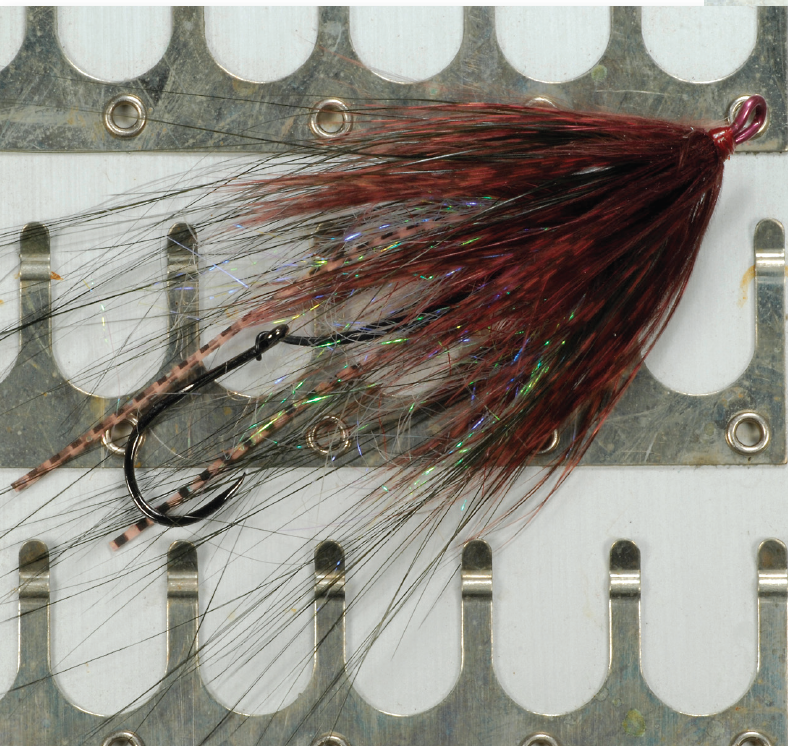
THE PINOT FLY
Shank: Pink Senyo’s Articulated Shank.
Connector: Black Senyo’s Intruder Trailer Hook Wire.
Hook: OPST Swing Hook, size 4.
Thread: Red gel-spun 14/0.
Dubbing ball: Claret SLF Dubbing.
Tail flash: Pearl UV MFC Minnow Body Brush.
Rubber legs: Black barred pearl Hareline Grizzly Flutter Legs.
Rear hackle: Claret speckled coq de Leon hen hackle.
Body: Claret MFC Micro Lucent Chenille.
Hackle: Claret saddle hackle, black cape hackle, and olive speckled coq de Leon hen hackle.
Head cement: Solarez Ultra-Thin.
There are many suitable reels on the market today for trout Spey, and aspiring anglers should visit their local fly shops to look over the range of options. Most anglers like the fast pickup of large arbor reels, but I find that a 3 5/8-inch-diameter Hardy Perfect balances my five-weight Spey rod and adds a vintage coolness to the experience. The only drawback is that I have to reel faster than I would when using a large arbor reel, but the sound of that vintage Hardy clicker is like music during a screaming run of a Deschutes River trout.
I am including a few favorite patterns for you to add to your fly box; the pattern recipes are pretty specific, but you can often substitute with your favorite materials. Pacific Northwest anglers, guides, and fly shops developed this selection. It includes soft hackles for fishing during specific hatches as well as a few searching type soft hackles. There is also a selection of streamers and Intruders for fishing western waters and beyond. All are ideal for when you want to try your hand at Spey trout fishing.
Glenn Zinkus is a regular contributor to this magazine. Glenn lives in Oregon.