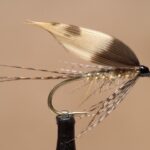
During the summer, when we are collecting insects from the stream, we often see small Baetis females laying their eggs. Their bodies are colored amber to reddish brown. All of these spinners have glossy, violet-purple-tinted wings. We tested a few patterns that could imitate these egg-laying spinners and discovered that the best imitation is tied using golden brown Ice Dubbing for the body and pale-violet sparkle fibers for the wings. We used brown partridge fibers or cul de canard for the legs.
At the beginning of August about 10 years ago, we used many different flies with mixed results. Next, we tried our Lavender and enjoyed astonishing success. The fish in our local river are shy—they see few anglers and spook easily—but in about five hours, we each caught more than 50 brown trout. Unfortunately, the day came to an end and we had to return home, but it was an unforgettable experience. The Lavendar seemed almost magical when fished on the surface or as a wet fly in the surface film; used deeper, it acted as a fish magnet. We thought we had a lucky experience, but as the end of the trout season approached and the fish became less aggressive and more shy, the Lavender remained our best pattern.
LAVENDER
Hook: Tiemco TMC531 or a similar hook, sizes 18 to 12.
Thread: Yellow 12/0 or a similar ultra-fine thread.
Body: Golden brown Ice Dubbing.
Rib: Tying thread.
Wing: Lavender Angel Hair or a similar sparkly wing material.
Legs: Cul de canard.
Tying the Remerger
What Does It Imitate?
Although we think the Lavender looks like a Baetis spinner, it might also be a good imitation of a few other insects the trout see. This fly can represent different naturals in various stages of development. For example, it is a great emerger and behaves like an adult going to the surface to emerge from its nymph shuck. The Lavender might also remind trout of a crippled mayfly. Sometimes a real mayfly becomes trapped on the surface: one or more legs cannot be released from its nymph skin, or a wing becomes stuck on the film.
We use cul de canard fibers for the legs and reduce the numbers of fibers for flies we intend to fish in shallow water. The Lavender has no tail; we haven’t noticed that the absence of a tail on this pattern is of importance to the fish. Besides the sparkly, semitransparent body of Ice Dubbing, the sparkle in the pale-violet wing could be an important trigger.

According to the theory of colors, warm colors are red through yellow, including browns; cool colors are blue and green through blue violet. It is said that warm colors arouse or stimulate the viewer (for example, red and orange are often used to attract a fish’s attention), while cool colors are calming and relaxing.
Some species of fish can see the ultraviolet end of the light spectrum. Fish sometimes use their sense of ultraviolet vision to locate food. For example, juvenile brown trout living in shallow water use ultraviolet vision to detect zooplankton. As they get older, they move to deeper waters where there is little ultraviolet light.
Can we really explain everything about successful fly fishing? If we try to make fly fishing an exact science, it would probably lose some of its magic and charm. No matter how hard we try to have the right fly for every situation, the fish give the final judgment. In the case of the Lavender, the trout have ruled in our favor many times.
Igor and Nadica Stancev are two of Europe’s leading designers of realistic fishing flies. They live in Macedonia. To see more of their great patterns, check out their website, www.fishingflies.com.mk.