Common Materials
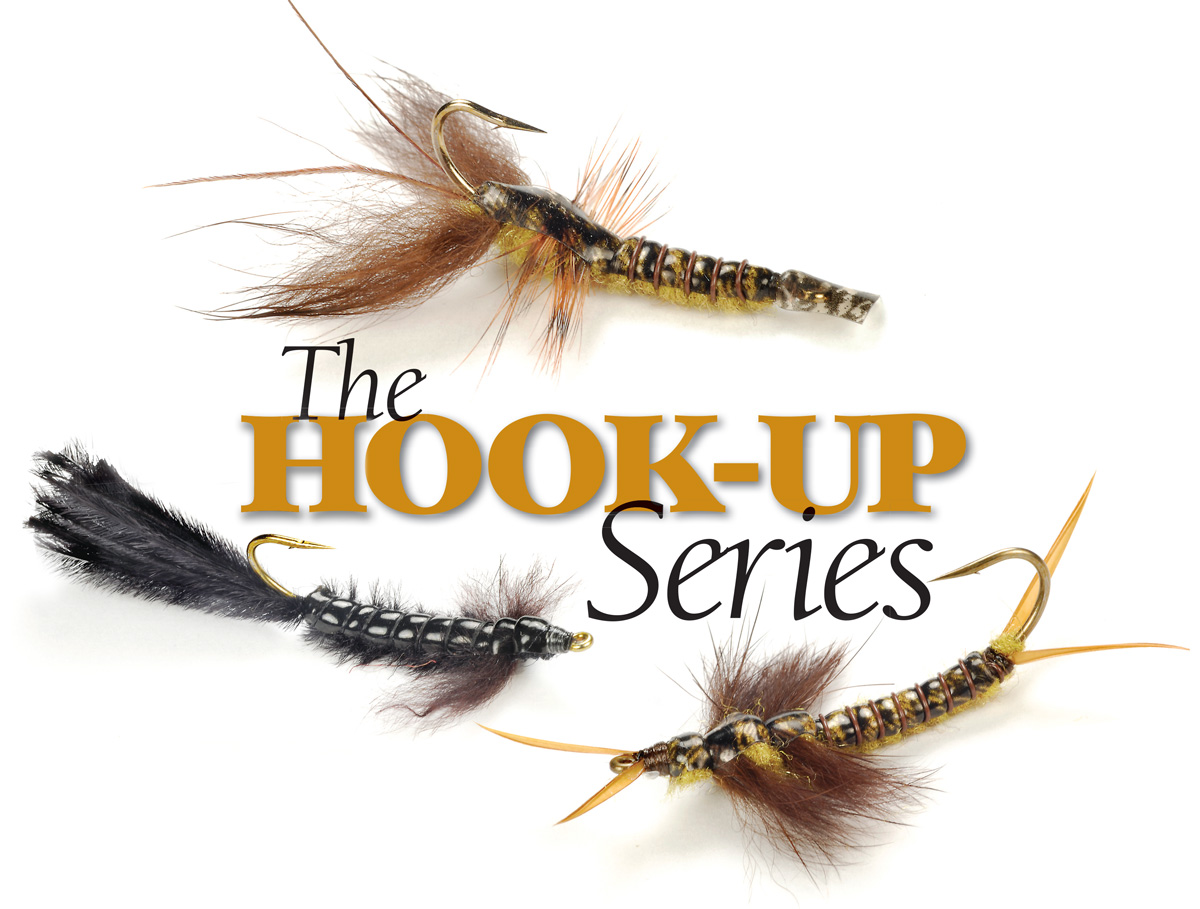
Tie the Hook-Up series using readily available materials. The following ingredients are common to all three flies.
HOOK AND WEIGHT Tie all three patterns using the same curved-shank, 3X-long, straight-eye hooks. The Tiemco 200R and the Dai-Riki 270 are just two examples of this type of hook, but several other manufacturers offer similar hooks. Add weight using pieces of .035-inch leadfree wire tied to the sides of the shank. This is heavy wire, but it gets the hook to turn over in the water. The two strips of wire also create a flat base that enhances the look of all three finished patterns.
THIN SKIN Make the backs of all three flies using Wapsi’s Thin Skin. Thin Skin is a thin plastic film on a paper backing. It comes in a variety of colors; the solid ones are opaque, and the mottled colors are translucent. The HookUp Hellgrammite uses black Thin Skin, and the Hook-Up Crayfish and Hook-Up Stonefly use natural mottled oak. Cut a strip of Thin Skin to the desired width, and peel the fi lm from the backing. Thin Skin is widely available at fly shops and from fly tying–materials suppliers.
RABBIT FUR Rabbit fur is very soft and provides good movement in the water. The Hook-Up Crayfish has rabbit fur claws, while the Hook-Up Hellgrammite and Hook-Up Stonefly incorporate rabbit fur, placed in a dubbing loop, for the legs. The technique is not difficult to learn, and it results in very soft, durable legs that add movement to the fly.
Begin by making a dubbing loop. Next, cut an appropriate amount of fur from the skin for making the legs of the fly; rabbit fur is available on whole skins, partial skins, and Zonker strips.
Insert the fur into the loop with the tips pointing to the rear. Clip the butt ends even. Pull the loop above the hook, and stroke the tips of the fur to the rear; the clipped butt ends are facing the front of the fly. (Moistening your fingers will help when stroking the fur.) Wind the loop forward in close wraps, continually brushing the fur to the rear while you work. When all the fur is wrapped on the hook, tie off and clip the remaining piece of loop. You can thin and shorten the legs to your liking by picking at the tips with your thumbnail and index finger.
RIB The Hook-Up flies have segmented abdomens to match the naturals. Making a tightly wrapped rib creates the segmentation. When I first developed these flies, I used strong thread for the rib, and sometimes I still do. Today I use Wapsi’s Ultra Wire, which comes in a variety of colors and several sizes, and adds even more durability to these flies. These materials are common to all three flies.
I use a few additional, easily obtained ingredients for tying specific patterns. For example, on the Hook-Up Hellgrammite, you’ll need wool yarn for the body, and ostrich herl for the extended body and gills. The Hook-Up Crayfish requires dubbing for the body, pheasant tail fibers for the antennae, and hackle for the legs. For the Hook-Up Stonefly, you’ll use dubbing for the body and goose biots for the tails and the antennae. That’s it: nothing exotic or hard to find.
HOOK-UP CRAYFISH
If hellgrammites are a delicacy, then crayfish can be considered a staple. Numerous studies have shown that in many waters, crayfish are the number one prey of smallmouth bass, and in some waters they are a predominant prey of trout. There are more than 300 species of crayfish in North America. Not only are there many species, but they all live and grow for several years. That means there are probably crayfish of various sizes almost anywhere we fish. Like all animals with exoskeletons, crayfish must periodically molt their shells and wait until new ones form. That “soft-shell” stage of development inevitably raises the question: Do fish like a soft-shell crayfish more than one with a hard shell?
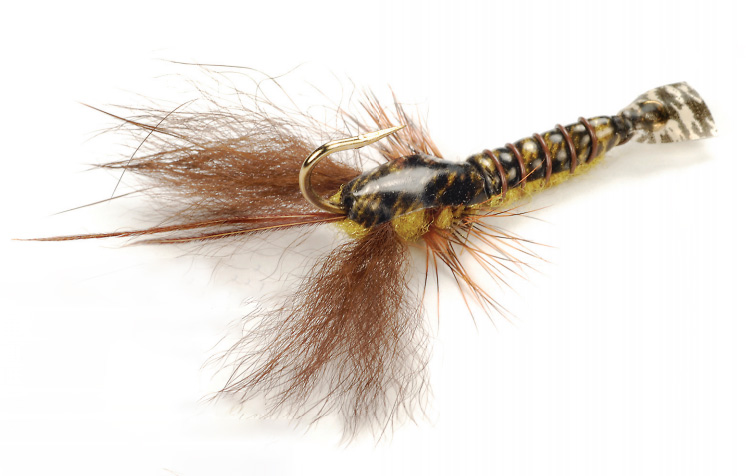
Ralph Cutter, in his excellent book Fish Food: A Fly Fisher’s Guide to Bugs and Bait, cites studies that indicate that when smallmouth bass have a choice, they will eat soft-shell crayfish before their hard-shell cousins. The key , however, may be “when they have a choice.” During the molt, crayfish retreat into hiding places until their new shells harden, which makes it harder for fish to get at them. So even though the fish may prefer the soft shells, the hard-shell crayfish, which are out and about on the river or lakebed, are easier to catch and eat. The Hook-Up Crayfish is a hard-shell imitation, and it is very effective.
The Hook-Up Crayfish has several characteristics in common with the Hook-Up Hellgrammite: a Thin Skin back, a ribbed abdomen, and rabbit fur for movement; in this case, rabbit fur claws. Some studies suggest that a good-sized crayfish with its claws in the defensive position can actually deter a fish from eating it, so make the claws fairly thin and equal to no more than half the length of the body. Hook size 6 or 4 is most appropriate for the HookUp Crayfish.
Fish the Hook-Up Crayfish in several ways. A dead drift can be very effective for imitating an injured or dying cray- fish, which is an easy meal for the bass or trout. Unlike hellgrammites, crayfish swim quite well when necessary. They crawl along the bottom looking for tasty morsels, but flee quickly, swimming backwards when confronted by anything dangerous. That means the fish are accustomed to chasing swimming crayfish. Make quick, short strips at the end of a dead drift, or make a cast up-and-across stream, allow the fly to sink, and then strip it across the current.
HOOK-UP CRAYFISH
Hook: Tiemco TMC200R, Dai-Riki 270, or a similar 3X-long curved-shank hook, size 6 or 4.
Thread: Brown 3/0 Monocord.
Antennae: Two pheasant tail fibers.
Weight: .035-inch lead-free wire.
Carapace: Natural oak mottled Thin Skin.
Thorax: Dubbing Dubbing color to match the local crayfish, color to match the local crayfish.
Claws: Brown rabbit fur.
Legs: Grizzly hackle dyed brown.
Abdomen: Same dubbing as the thorax.
Rib: Brown Monocord thread or medium Ultra Wire.