Dr. Kageyama experimented with fluorescent colors at various water depths and under different water conditions. He found that fluorescent orange and yellow are the most visible colors in stained water up to five feet deep. His findings back my on-stream observations.

Torrey’s Favorite
Hook: Czech nymph or grub hook, sizes 14 through 8.
Thread: Dark brown 6/0 (140 denier).
Body: Hare’s-ear dubbing.
Under rib: Gold holographic tinsel.
Back: Tan Scud Back. Over rib: 6X monofilament.
Hot spot: Fluorescent orange hare’s-ear dubbing.
Head: Black hare’s-ear dubbing.
Fluorescent red is also an option for hot spots. A fish’s eyes contain a chemical that make them extra sensitive to the color red; the same way words that are underlined with a highlighter seem to jump off a page, a fly tied with red seem to jump into a fish’s field of vision. To a human, red turns dark under the water, but a trout still interprets it as red. A fly tied with a fluorescent red hot spot is best used in clear, shallow water because the fish see the spot in addition to the rest of the fly; at deeper depths or in dirty water, red doesn’t create enough contrast with the rest of the fl y and it doesn’t elicit as many takes.
Where to Place the Hot Spot
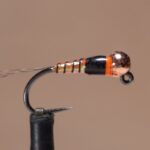
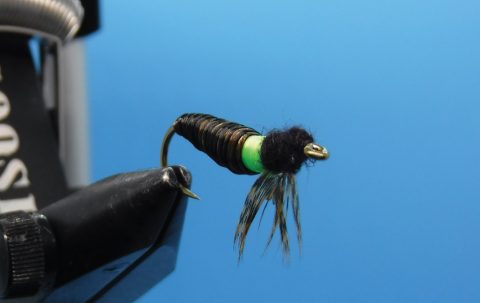
Placing a fluorescent thread collar behind a bead head creates sharp contrast between the nymph body and the bead. When the nymph is placed under an ultraviolet light, the only color on the entire fl y that is emitting any reflection is the fluorescent band of thread. This enables the trout to see the fly coming from a far distance, which is an advantage when fishing turbulent pocket water; in faster water, fish do not have ample time to inspect your fly, so they see the bright color and strike quickly.
Incorporating a tiny hot spot at the tail of the fly works well in areas where the trout have been subjected to heavy angling pressure. By tying the hot spot at the end of the fly, the contrast and color absorption of the fluorescent thread are still the key, but this spot is smaller and more subdued than a thread collar behind the bead.
I will tie a micro nymph with the hot spot behind the bead or at the tail of the fl y, but not at both ends. I have experimented with hot spots at both ends of a fly, and they seem to deter, rather than attract, the trout. My observations lead me to believe that two hot spots confuse the fish: they see a trigger at both the head and tail of the fly, are unsure which end to explore, and so reject the pattern altogether.

The Firefly
Hook: Standard nymph hook, sizes 18 through 10.
Bead: Fluorescent orange tungsten.
Thread: Dark brown 6/0 (140 denier).
Tails: Wood duck fibers.
Abdomen: Tying thread.
Rib: Small copper wire.
Thorax: Peacock Ice Dubbing.
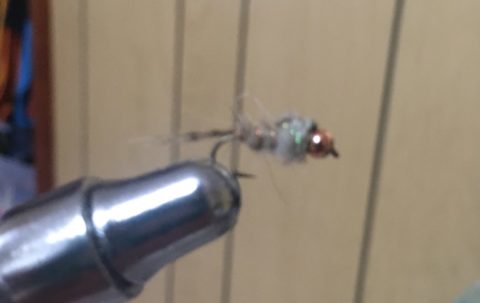
Instead of tying a fluorescent thread collar behind the bead head, why not use the bead itself as the hot spot? Fluorescent orange, pink, and chartreuse beads work well in high, stained water, but I was surprised to find that they also work well in low, clear water. In New Jersey, the Pequest River is home to large trout that get chased by fishermen every day from dawn until dusk. The water level gets quite low in the winter, and anglers sight-fish to the trout. Fish that are typically tough to catch on small midges react quite aggressively to size 18 to 14 nymphs tied with fluorescent tungsten bead heads. Watching these fish eagerly strike flies time after time has proved that reaction strikes occur more often than we think.
Add a Hot Spot to the Middle of the Body
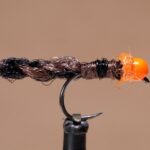
Using pink and orange UV dubbing in the middle of the abdomen of flies such as caddis larvae makes a huge difference in the ability of these patterns to catch fish, especially in deeper water. The fish seek out the larval shape of the real insects, and the hot spots draw the attention of the fish.
On a local limestone creek in eastern Pennsylvania, the forage is primarily small mayfly nymphs and tiny midge larvae. The best fl y for fishing this stream is often a Czech-style rock worm larva with a pearl foil back and pink hot spot. The midges and mayflies greatly outnumber the caddis larvae, and after not catching any fish using a natural-looking caddis larva, I switched to a large caddis larva with a pink hot spot in the abdomen and caught dozens of fish.
When I was introduced to hot spots, I was very resistant to the idea. I could not wrap my mind around the fact that something so unnaturally colored would catch more fish; this required me to go against my better judgment. But my willingness to try new techniques and reading Dr. Kagayama’s book caused me to experiment with hot spots on flies. I learned that even the most abstract and far-fetched idea has practical applications. I encourage all skeptics to try incorporating hot spots into some of their flies. Little things often make big differences.
Aaron Jasper is always experimenting with new fishing techniques, and he readily shares what he discovers with our readers. If you’d like to learn more about European nymph-fishing methods and flies, check out his DVD, European Nymphing: Techniques and Fly Tying.
Fly Box

Hot Spot Czech Nymph
Hook: Czech nymph, sizes 14 through 8.
Thread: Olive 6/0 (140 denier).
Body: Olive SLF Spiky Squirrel dubbing.
Under rib: Gold holographic tinsel.
Back: Light olive Scud Back.
Over rib: 6X monofilament.
Hot spot: Fluorescent pink hare’s-ear dubbing.
Head: Black hare’s-ear dubbing.

Stockie Basher
Hook: Jig hook, sizes 16 through 10.
Bead: Copper tungsten.
Thread: Dark brown 6/0 (140 denier).
Tails: Medium coq de Leon.
Abdomen: Tying thread.
Rib: Small copper wire.
Thorax: Light pink Ice Dubbing.
Hot spot: Fluorescent pink 6/0 (140 denier) tying thread.
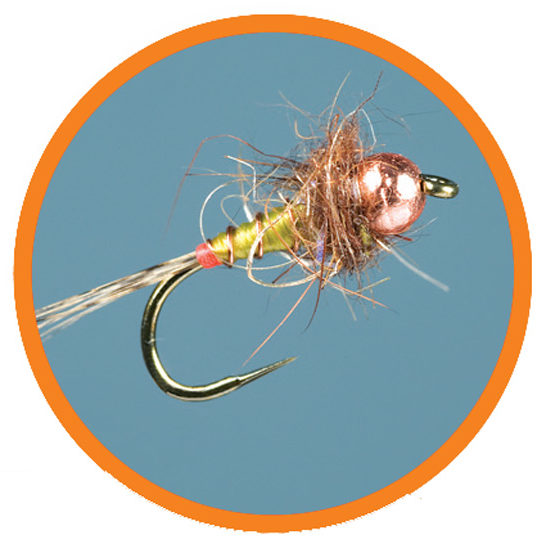
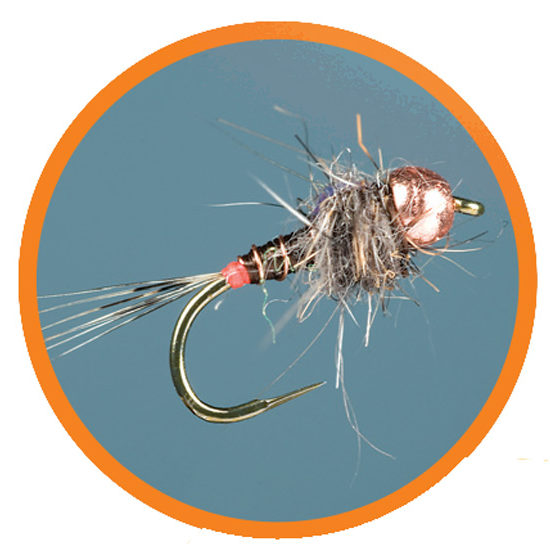
Tooth Decay
Hook: Standard nymph hook, sizes 18 through 10.
Bead: Copper tungsten.
Thread: Yellow olive 6/0 (140 denier).
Tail: Medium coq de Leon.
Abdomen: Tying thread.
Rib: Small copper wire.
Thorax: Natural gray SLF Spiky Squirrel dubbing.
Hot spot: Fluorescent fire orange 6/0 (140 denier) tying thread.
Double Dipper
Hook: Standard nymph hook, sizes 18 through 10.
Bead: Copper tungsten.
Thread: Yellow olive 6/0 (140 denier).
Tail: Medium coq de Leon.
Abdomen: Tying thread.
Rib: Small copper wire
Thorax: Natural gray SLF Spiky Squirrel dubbing.
Wing case: Large holographic tinsel.
Hot spot: Fluorescent fire orange 6/0 (140 denier) tying thread.
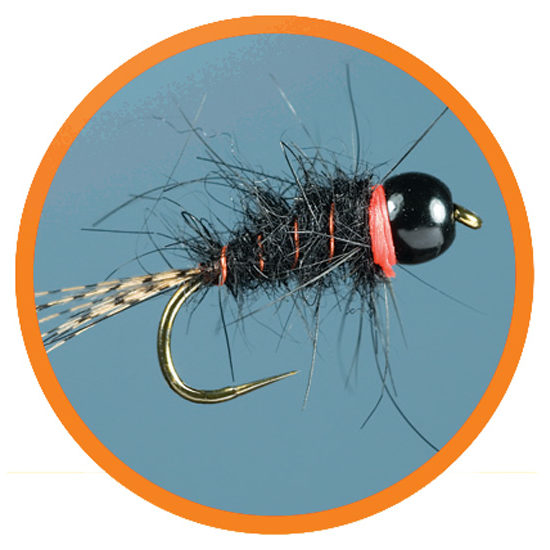
Black Out
Hook: Standard nymph hook, sizes 18 through 10.
Bead: Matte black tungsten.
Thread: Black 6/0 (140 denier).
Tails: Wood duck fibers.
Body: Black SLF Spiky Squirrel dubbing.
Rib: Small hot orange wire.
Hot spot: Fluorescent fire orange 6/0 (140 denier) tying thread.
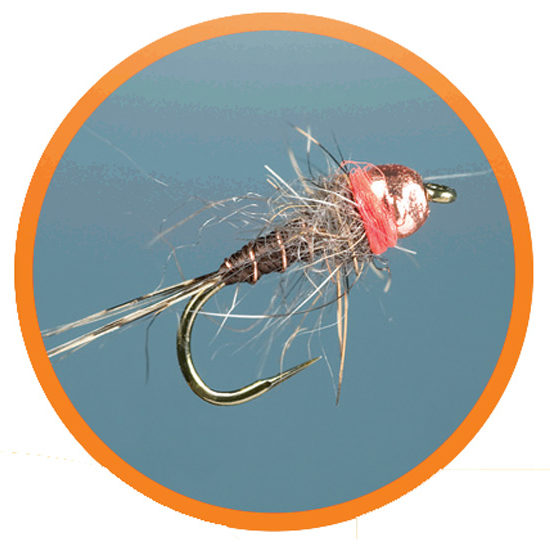
Root Canal
Hook: Standard nymph hook, sizes 18 through 10.
Bead: Copper tungsten.
Thread: Dark brown 6/0 (140 denier).
Tail: Medium coq de Leon.
Abdomen: Tying thread.
Rib: Small copper wire.
Thorax: Gray SLF Spiky Squirrel dubbing.
Hot spot: Fluorescent fire orange 6/0 (140 denier) tying thread.