Anchovy Bucktail Flat Wing
HOOK: Tiemco TMC811S, size 8.
THREAD: White 6/0 (140 diameter).
TAIL: White bucktail, and white, lavender, and pink saddle hackles.
BODY: Pearl Bill’s Bodi-Braid.
UPPER WING: Sparse amounts of pink and olive bucktail.
LOWER WING: White bucktail.
EYES: Black marker or 1/8- inch-diameter silver prismatic eyes.
Always a magnet for celebrity sightings and tourism during the summer months, Martha’s Vineyard is the first location where false albacore appear in the Northeast. Capt. Phil Cronin has extensive knowledge of the island and the local fishery, and he is a top competitor in the annual Martha’s Vineyard Fishing Derby.
The derby is held each fall for almost five weeks during September and October. This is prime time for catching false albacore, and Phil’s clients have fared well with three first-place and two second-place finishes, all on flies. This record elevates him into an elite status among the competitors.
Phil’s most productive go-to pattern is the Scotty Fly. This sand eel imitation, which was developed with angler friend Scott Patterson, has been perfected and tweaked throughout the years. It’s tied with a blend of synthetic and natural materials, and finished off with epoxy for a lifelike, durable appearance.
Bay anchovies follow the eddy currents that fl ow from the Gulf Stream into Nantucket Sound. The Mighty Whitey and Mini Bait Fry are two of Captain Cronin’s patterns for imitating these small baitfish. A fast two-handed retrieve works best for mimicking a fleeing bay anchovy, and the fish will not notice a 12- to 20-pound test fluorocarbon leader.

Joe Blados’s Bay Anchovy Crease Fly
HOOK: Mustad Signature S74SZ, size 1.
THREAD: Flymaster Plus, white.
TAIL: Tan over white bucktail, strands of silver, pearl, and gold Krystal Flash.
BODY: 2-millimeter-thick white adhesive-backed foam covered with silver holo- graphic foil and colored with permanent markers.
GLUE: Zap-A-Gap CA+ on the hook shank.
EYES: 3 /16-inch-diameter silver prismatic eyes coated with epoxy
Moving to Rhode Island, my home waters, I fish for false albacore around the boulder fields often called the Watch Hill Reef Complex. These jagged rock outcroppings were left by the retreating glaciers during the last ice age. These rock piles provide ideal points for albies to ambush their prey.
Watch Hill offers fishing for every type of light-tackle angling, and there is always a crowd of fishermen once word spreads that the action is hot. Spotting bird activity is the key, and the fishing can be fast and furious with boats constantly repositioning over moving fish.
The local bait includes bay anchovies, butterfish, sand lances, and silversides. A good array of shorter, transparent patterns work best. Some flies, such as sand eels, will have narrow profiles, but also tie some taller flies to imitate butterfish and peanut bunker.
Capt. Merritt White is a native son of Eastern Long Island. Merritt has explored every sand bar and cove as a young adult, and he understands the complex interactions of tides, marine life, and weather. His vast knowledge and experiences pay dividends as clients of all abilities benefit from his tutelage. Captain White has been plying the local waters professionally for more than 10 years with a great amount success. In addition to Montauk, he poles the shallow flats of Shinnecock and Gardiner’s Bay. Clients learn to fish many diverse situations for a memorable day on the water.
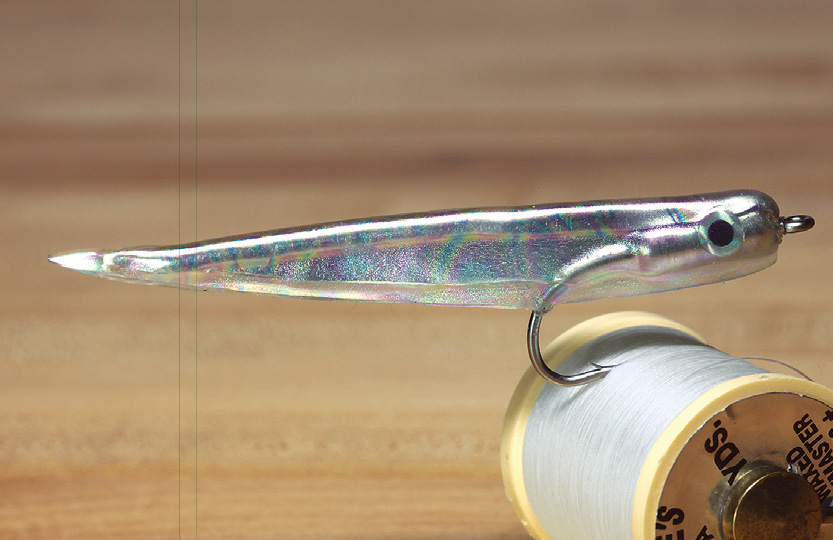
Blane Chocklette’s Gummy Minnow
HOOK: Mustad Signature 34007, size 2.
THREAD: Flymaster Plus, white.
WEIGHT: .030-inch lead wire.
BODY: Sili Skin, folded on the hook and cut to shape. Select silver and other fishy colors.
EYES: 3 /16-inch-diameter silver prismatic eyes covered with mother-of-pearl Sili Skin. Fold the Sili Skin over the eyes and body of the fly, and cut to shape. Start the thread behind the hook eye and tie down the nose of the fly
Montauk Point, at the tip of New York’s Long Island, just might be the Holy Land of autumn saltwater fly fishing. The waters around the lighthouse at Montauk have traditionally been one of the hottest places to fish for false albacore during late September and early October. Thousands of them pound the bait-laden waters at the very intersection of two major migration routes: the Atlantic Ocean and Long Island Sound. Strong currents push the rain bait close to shore during the dropping tides and make it ideally suited for wading and fly fishing. As an added bonus, striped bass fishing is surreal during Columbus Day weekend; you could swear that all the striped bass along the entire Northeast Coast are here. Pick between catching albies or stripers, or do both; it’s a fantastic day of fishing!
The Big Apple is our last stop on the Northeast false albacore trail. Deep in the heart of Yankee pin stripes, Capt. Joe Mustari performs his angling magic among the tall skyscraping silhouettes and bustling traffic of New York City. The city is best known for its diverse culture and Broadway lights, but local residents know a different side.
The local angling cult based on Staten Island sees the city as a fishing paradise. The island is a hotbed of fly fishing diehards: Paul Landgraf, Joanie and Dale Sharrott, Gary and Mark Sherman, and Ricky Fink, among others, put in a good day on the water before rush hour traffic even begins. Two major freshwater tributaries, the Hudson and the East Rivers, converge and empty in lower Manhattan, forming a deep gorge basin ideally suited for all forms of baitfish, and large shipping vessels continually scatter the bait supply, making for some good topwater action.
Captain Mustari is always alert and up to the task each morning. Conditions here can change in the blink of an eye. It’s a fast-paced fishery, but being a native New Yorker, Captain “Maz” can make any tourist feel at home. New York City may be one of the best-kept secrets when it comes to great late-autumn fishing.
Fill your vest with the accompanying guide-tested flies. These patterns are your ticket to some of the fastest saltwater fly-fishing action in the Northeast.
Capt. Ray Stachelek is one of the hottest guides on the coast of Rhode Island. Captain Ray is also a regular contributor to this magazine. For more information about his flies, guide services, classes, and more, go to his website, www.castaflycharters.com.