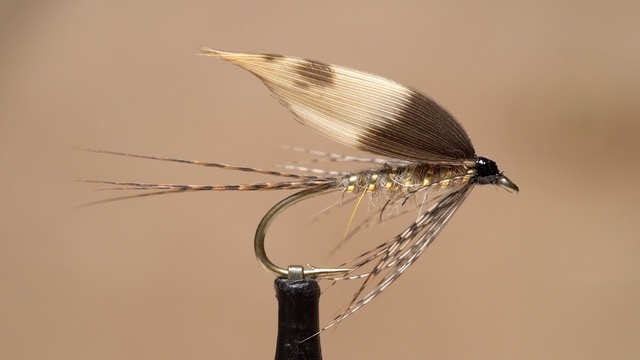
Mastering the Welsh March Brown — and the challenging wing techniques that make it a deadly fly.
Before we get started, just a word of warning to you beginner and intermediate tiers — everything about this pattern is fairly easy to tie except for the final couple of steps. In terms of skill building, however, I believe that these difficult steps are absolutely worth learning and practicing.
My fascination with the pattern started a couple of years ago when I was invited to do a Tie-Off, against none other than legendary fly tier and guide Davy Wotton, at the Sowbug Roundup in Mountain Home, Arkansas. I stressed and practiced tying this fly, the Welsh March Brown, for a good four months before heading south for the Roundup. Up until the event, I was setting the wings correctly only about 50% of the time.
On the day of the Tie-Off, the fly tying gods were apparently shining down on me, and I set the wing about as well as I possibly could. By applause reaction from the crowd, the competition was declared a draw, about the best result I could ever imagine.
Since then, I’ve continued not only tying the pattern but fishing it as well, and I’m pretty happy with the results of both. I like to fish it in a tandem rig, usually behind a rather floaty parachute-style fly. Cast upstream and slightly across, the March Brown drifts in the surface film or just below it, while the parachute acts as an indicator. What’s sort of remarkable to me is how often I’ll get a take on the March Brown at the end of a drift, just as I’m beginning to re-cast. I kind of get the feeling that trout will track the fly for a while as it dead drifts but the slight pull, right before a re-cast, triggers them to take. That’s my theory anyway.
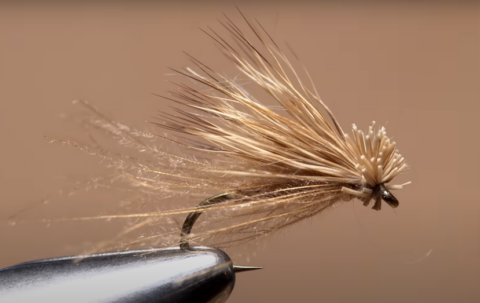
In terms of tying, the only material that can be a little difficult to get a hold of are a matched set of hen pheasant wings. If you know of any bird hunters, they can be an excellent source. Although other materials, like mottled turkey, can be substituted, I think that hen pheasant has just the right markings, length and foldability. It’s important to use the leading edge from the secondary feathers of the wing as opposed to the primary feathers, where the fibers are too short, or any of the trailing fibers on the wings, which although long, are generally too soft.
This Welsh March Brown may not be your cup of tea to tie or to fish but, preparing and setting the hen pheasant slip wing is a skill that is well worth learning, and can be translated to a whole slew of wet fly patterns. Not to worry if the wings don’t set perfectly, as the fly should still fish well. A special thanks to Davy Wotton for suggesting this pattern for the Tie-Off, as learning it and tying it has definitely made me a better tier.
Welsh March Brown
Detailed instructions for tying a Welsh March Brown wet fly. This is part of a series of Tim Flagler’s collaboration with Fly Tyer Magazine. Check out his article about the fly in the Spring 2026 issue of Fly Tyer Magazine. Recipe: Hook: Fulling Mill 5105, size 12.
About the Author:
Tim Flagler is a leading fly-tying instructor, appears at tying shows across the United States, and guides anglers to fly-angling destinations around the world. To learn more, visit tightlinevideo.com. Tim and his wife, Joan, live in New Jersey.