Take a Clue from Permit Anglers
It’s rare to feel a carp take a fly. More often, strike detection requires precise focus on the fish’s body language. It helps to be close enough to see the white wink as a carp opens its mouth near your fly; usually the take will be even more subtle. If the fish tilts down, turns its head, thrusts forward, or does anything else weird near your fly, it might be striking. The amount of time it takes for a carp to inhale and then expel your fly is less than the time it takes to read this description, so take a cue from permit anglers: If you suspect that a fish has eaten your fly, strip-strike with the rod held low, even when the fish is at close quarters. Next to using stealth, casting accuracy is the most critical factor in taking carp on the fly. Casting accuracy is a predicate for any hope of strike detection, and experienced carp anglers talk about putting the fly on the “pie plate.”
Imagine an 8- to 10-inch-diameter plate centered under the carp’s nose. That’s your ultimate target. Realistically, the dimension of the pie plate will vary depending upon water clarity; sometimes you can cast directly to the plate, especially with an actively feeding fish, but more often than not a cast directly to the target will send the fish into the next zip code. The trick is to get the fly into the pie plate without spooking the fish. The best approach is to cast the fly ahead of and beyond the carp, and wait for the fish to see the fly, or to slide the fly into the strike zone just as a tarpon angler does. Of course, exactly where to cast depends upon how the carp is behaving.
Clouser Swimming Nymph
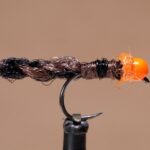
Bob Clouser’s Swimming Nymph is a classic. It is such a well-known pattern that I hesitated including it with a new batch of carp flies. However, this pattern is so effective that it deserves a place in any carp angler’s fly box. Henry Cowen, renowned for innovative and productive f y tying, sealed the deal when he rated the Clouser Swimming Nymph as his “absolute, positively best go-to carp pattern.” Henry likes to fish this fly without added weight; he simply casts it to the pie plate, allows it to slowly sink, and then, if there is no strike on the fall or after a few gentle twitches on the bottom, he casts again. Henry and I both like a rusty brown version of this fly tied in size 10. This pattern is perfect for catching spooky crawlers, carp that are feeding in such skinny water that their backs are exposed.
Hook: 2X-long nymph hook, sizes 10 to 4. p hook, sizes 10 to 4.
Thread: Fire orange 6/0 (140 denier).
Tail: Dark brown marabou or rabbit fur, and bronze Flashabou or Krystal Flash.
Body: Dark rusty dubbing.
Wing case: Peacock herl.
Legs: Brown or speckled brown henhackle

Picking the Right Carp
Carp are either feeding or lying dormant, and casting to a dormant carp is futile. The ability to recognize a fish that might take your fly is essential. Sure, you can always cast and hope, but doing so usually spooks a non-feeding carp, which then spooks every other fish within range like scaled dominoes falling across the carp flat. Don’t do this! Instead, learn to identify these basic carp behavioral modes: sunbathers, cruisers, crawlers, mudders, and tailers.
Sunbathing carp suspend parallel to the bottom absolutely motionless, and are a waste of casting effort. Sure, there’s always an exception that proves the rule, and if there are no other fish in the vicinity, go ahead and try with a subtle fly like a Clouser Swimming Nymph, Mean Old Dirty Frisco, Hare’s-Ear Nymph, or even a Bactrian Worm. If there are other fish within range, however, leave the sunbather alone to enjoy the rays.

Poling and casting platforms on a wide, ultra-stable quiet boat make the perfect carp fly fishing craft.
A cruiser is an animal that comes in several varieties. A quick-moving carp is not a good candidate to eat a fly. What you really want is a fish that is cruising slowly with no apparent destination in mind. If the carp occasionally stops, noses down to the bottom, or idles to either side, that’s your huckleberry! Pick a fly based upon the water depth and clarity, get it on the pie plate without spooking the fish, and you will have a chance to sharpen strike-detection skills.
A crawler is a really slow, hungry fish moving in just inches of water. These are tough fish for me to catch, but other anglers like them a lot. Casting fine and far off with a Hare’s-Ear or Swimming Nymph will work, but aiming directly at the pie plate will almost always spook a crawler.
On the other hand, casting directly to the plate often works for both mudders and tailers. A mudder is really a tailer that is actively feeding in water too deep for its tail to break the surface. Both types of fish tend to kick up mud or silt while standing on their heads feeding. These are my favorite fish. A bonefish-style weighted fly is a perfect first choice. Good examples include Carp Crack, Headstand, Carp Devil, and Hogan’s Carp Bait. Sometimes, a tandem rig with a weighted fly at the end and a San Juan Worm as a dropper works even better. Two flies double the chances of a carp seeing your offering in a cloud of silt.

Hare’s-Ear Nymph
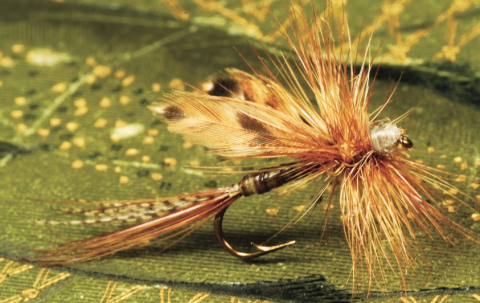
Sometimes only a small nymph fished fine and far off will take carp. I’ve done it with Bead-Head Prince Nymphs and Pheasant-Tail Nymphs; either of those patterns could be on my favorites list. Yet, the simple Hare’s-Ear Nymph has proved superior for my carp fishing. When the water is clear, the sky is bright, and carp are shallow and nervous, it’s time to reach for a 6-weight rod with a 12- to 15-foot leader and 5X tippet. Ty Goodwin, of Mean Old Dirty Frisco fame, is really adept at using a size 10 Hare’s-Ear dropped about 10 or 12 inches below a Turk’s Tarantula or similar dry fly; I’ve done it using a Madam X. Finicky carp like this approach, and a fish’s take of a small, suspended nymph is hard to detect; the dry fly acts as a strike indicator. Ty has a neat trick to make strike detection even easier: If you think that a carp has the nymph, strip the dry fly toward you. If it sinks, the carp is on, and a strip strike seals the deal. Even if the dry fly skates toward you without indicating that a fish on, the movement may trigger a hovering carp to eat the Hare’s-Ear. Add a small gold bead if you want the fly to sink a little faster.
Hook: Thread: Brown 8/0 (70 denier).
Tail: Hare’s mask (guard hair) fur.
Body: Light hare’s-ear dubbing.
Rib: Medium gold wire.
Wing case: Turkey tail quill or pheasant tail fibers.
Since both tailers and mudders are focused on the bottom, they can be approached more closely than carp in other behavioral modes. Stealth is still essential, but being able to close the range makes strike detection a little easier. When the fly is near the pie plate, watch the tail for any “tells” that the fish has Hoovered up the bait.
Carp on the fly is a contagious obsession. If you take steps to counter the sharp sensory array of a typical carp, increase your casting accuracy, and try these 12 favorite carp flies, you will fall under the same golden magical spell that I love so well.
This was Pete Elkins’s first submission to our magazine. Pete lives in Alabama.